Egypt smells of jasmine, and your perfume probably starts here
If you have ever worn a perfume with jasmine in it, there is a fair chance the scent began in a field by the Nile, sixty odd miles from Cairo, somewhere around midnight.
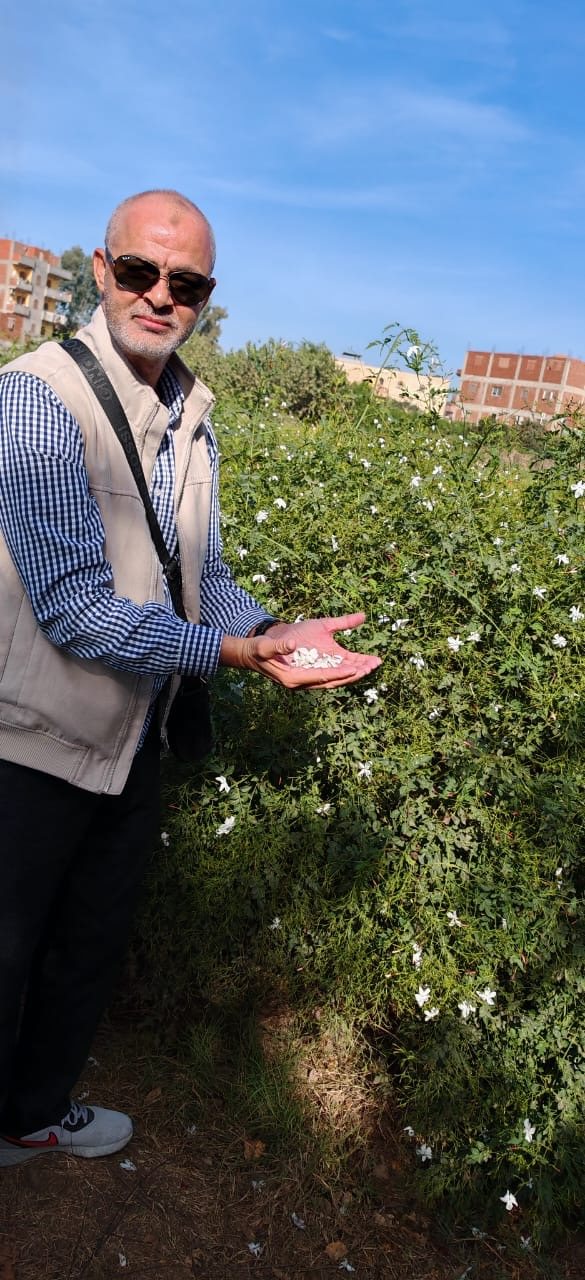
My family grew jasmine in the Nile Delta for generations. I mention it not as decoration but because it explains why, in the photograph above, I am standing in a field holding a handful of flowers as though that were the most ordinary thing in the world. Where I come from it is. The whole working calendar of a village arranges itself around one plant.
Two countries, almost the whole world
Egypt and India together supply roughly 95 percent of the world's jasmine absolute, the concentrated extract that goes on to the perfume houses. A handful of other countries split what is left. Which means nearly every bottle with jasmine in it carries a piece of an Egyptian or Indian field, whatever name is on the label and wherever the brand keeps its offices.
The Egyptian end of it sits in the Delta, in Gharbia governorate, about a hundred kilometres from Cairo. The best known village is Shubra Beloula, where around fifteen thousand people live on under three hundred acres and most of them live off jasmine. It appears on no tourist map of Egypt. In the supply chain of global perfumery it is one of the more important addresses there is.
Why the picking happens at night
Work starts around midnight and runs for a few hours past dawn. The reason is simple and easy to miss: the jasmine flower only opens after dark, and that is when it is at its strongest. By morning, in the sun, the scent has gone and a flower picked then is worth considerably less. Buds that have not opened are left for the following night.
The second reason is more down to earth. The Delta in season can be brutal, and work in a field after dark is simply bearable. The season runs from roughly April or June through to November or December depending on the year, so for half the year a village like that lives upside down. You work at night and sleep in the afternoon.
All of it by hand
Jasmine cannot be harvested mechanically. The flower is too delicate and is taken one at a time, stem and all. An experienced picker brings in two to five kilos a night and is paid around two and a half dollars a kilo. At the height of the season Egypt gathers something like twenty tonnes of flowers a day, which means thousands of pairs of hands working in the dark at once.
What comes out of those tonnes is startlingly little. Gharbia produces about five tonnes of the thick jasmine paste called concrete across a season, and the oil itself is drawn from that. The entire Egyptian jasmine industry is worth something in the region of six and a half million dollars a year. Less than the advertising budget of a single fragrance.
The French connection
The jasmine growing in the Delta today did not arrive by accident. The largest processing plant in the area was founded in the nineteen sixties by a man who brought cuttings back from Grasse, the capital of European perfumery. That one factory now handles most of the flowers in the governorate.
The reversal is rather good. France taught Egypt to grow jasmine at scale, and Egypt went on to supply France. Climate turned out to be the stronger argument: in the Delta jasmine flowers for most of the year, in Provence for a few weeks.
Drought is changing the arithmetic
The last few seasons have not been kind. Heatwaves and erratic rain shorten the flowering and cut yields, while the price paid at the gate has not kept pace with costs. Growers have been saying so for years. None of it shows in the price of a bottle in a shop, because the raw material is a rounding error there.
What this means if you are in Hurghada
The fields are a long way from Hurghada, in a different part of the country, so this is not an afternoon out. It is worth knowing about anyway, because oils and perfume are one of the few Egyptian souvenirs that genuinely make sense. The raw material is from here rather than shipped in from the other side of the world and repackaged in a box with a pyramid on it.
The problem is that the oil shops in the resorts are set up for tourists rather than for people who know what they are looking at. Before you buy:
- Real jasmine absolute is very expensive, so a bottle costing a few euros is not it. It is a blend on a carrier oil.
- That is not in itself a swindle, provided the seller says so plainly and the price reflects it.
- The first price quoted in a tourist shop is often several times the real one. Haggling is the norm here, not an insult.
- Try it on skin and give it fifteen minutes. Cheap compositions fall apart fast.
If you are planning that kind of shopping, message me before you head out. I will tell you what to look for and roughly what it should cost. And if you are interested in trips around Egypt, I put them together so they do not end in three souvenir shops along the way.
Where the figures come from
The share of world production held by Egypt and India comes from IFEAT industry figures. The details on Shubra Beloula, the picking hours, the rates paid and the volumes come from agency reporting published in 2025. These are seasonal numbers and they move from year to year, particularly as drought and heat bear down harder on the crop.